Block-Long Mural on Indian St.
Was Impetus for New Coalition
By Matthew Goldberg
Brooklyn Daily Eagle
NORTH BROOKLYN — Williamsburg is not for just hipsters anymore, but actual artists, too!
Such are the aims as presented by the inaugural meeting of the North Brooklyn Public Art Coalition (NBPAC) at a community gathering held here at the Brooklyn Brewery on Wednesday, Feb. 25.
Close to 100 attendees filled the public space of the brewery — curious artisans, curators and others, who came to hear the speakers speak and enjoy some complimentary beer — as the brewery’s cat, Monster, roamed the floor.
The main objective of the meeting was “to open a discussion among artists of North Brooklyn about the opportunities for public art exhibition and funding in our area.” And the evening was essentially designed as a venue for representatives from assisting organizations to show existing examples of public art and how to apply for such a project, and for those in attendance to ask questions.
As Danny Kanner, press secretary for David Yassky, told the Eagle, this is “an ‘artistic’ neighborhood ... there is a real demand — especially right now, even with economy — for public art. This is David’s work with the community group.”
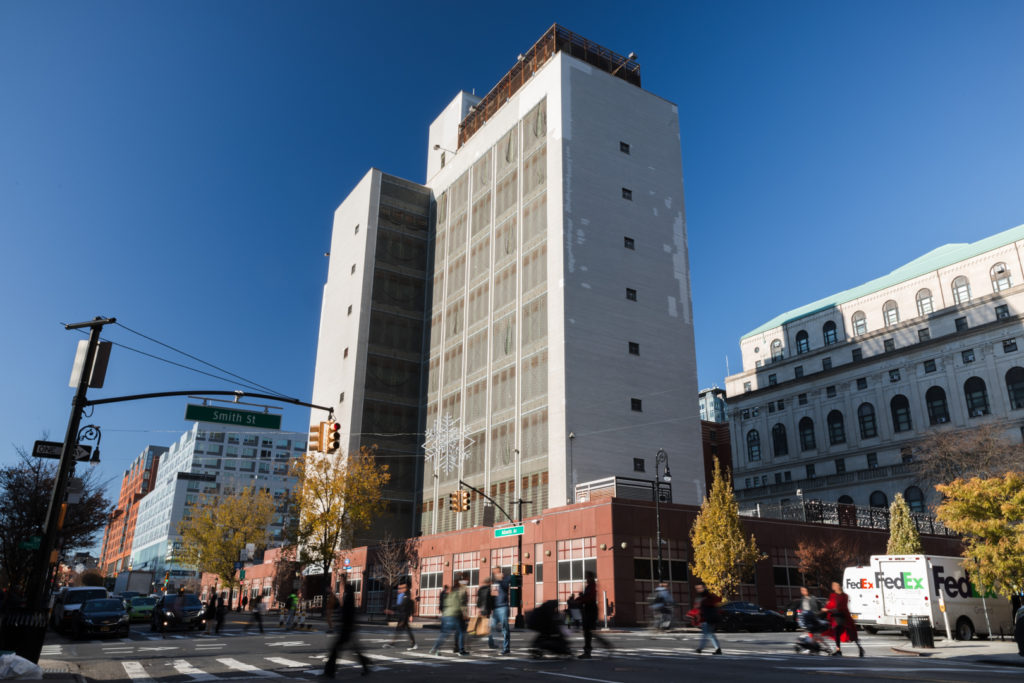
The India Street Mural in Greenpoint, said Kanner, was the motivating factor for the Coalition’s inception. The building, which provides for a block-long wall mural, sits at the tail-end of India Street and is owned by Dean Palin (no relation), who Yassky approached about providing some local color.
Palin “was happy to do it,” said Kanner. “That’s what started the whole concept of the Coalition. [The mural] was the passion that invoked the project,” to which a “reaction poured in proving that there was an environment for this,” he said.
Stephanie Thayer, executive director of the Open Space Alliance for North Brooklyn (OSA) and administrator for the NYC Park Dept. in Williamsburg and Greenpoint, stressed that emphasis for public art was “not just on sculpture and paintings, but performance” as well.
She, along with the other organizers, was overwhelmed by the turnout here on Brewer’s Row. (Steve Hindy, cofounder of the Brooklyn Brewery, sits on the board of the OSA.)
‘Don’t Need To Go to Manhattan’
Rami Metal, community liaison for David Yassky and District 33 spearheading the Coalition, said, “We’re not an arts organization and we’re not artists.” But they want to do all they can for artists in the district, he said.
Metal laid out steps an individual or group of artists can take, from identifying potential sites, to acquiring funds — ie, from elected officials, or through organizations like the NEA — and how to further initiate and develop projects in Brooklyn by spreading the word.
“We don’t need to go to Manhattan for public art,” Metal said. “But, people are pretty excited about the coalition and the mural and have been asking us how they can be involved,” he told the Eagle.
Jonathan Kuhn, director of arts and antiquities for the NYC Parks Dept., opened things off declaring that there is “a great need, and a great precedence,” for temporary installation of sculpture in parks.
Kuhn runs Art in the Parks, a temporary art program whereby “emerging and established artists exhibit their works in NYC parks, playgrounds and traffic islands in the five boroughs.” He was here to show recent examples of “what we do and what we don’t do.”
Clarifying how District 33 goes “along the waterfront, and then takes a vicious turn to Grand Army Plaza,” he highlighted exhibitions that are “inexpensive in terms of materials or installation costs” but work that is otherwise “responsive to sight.”
One work Kuhn mentioned was Leonard Ursachi’s “Hiding Place,” installed at the entrance to Prospect Park facing Grand Army Plaza for the summer of 2007. The piece, as pictured, was “an enclosed cylindrical hut that was 8 feet tall, 8 feet wide and made from woven willow branches,” wrote Beth C. Aplin in this paper in 2007.
“Prospect Park is such a wonderful setting to display art,” said Prospect Park Alliance President Tupper Thomas at the time. “Especially a work like this that references nature and engages viewers’ imagination.”
Kuhn also cited the LeAp Public Art Program, “a mentoring program to create public art,” he said, where middle-school students empower themselves “to speak out on social issues in their communities — gangs, drugs, violence, cultural diversity, etc. — through the creation and public exhibition of art in NYC parks... using a school lunchroom table as a canvas.”
This program is set to commence May 28, 2009, as a joint venture with the NYC Department of Education and the mayor’s office, and will carry a “strong and explicit social message,” said Kuhn.
Emily Colasacco, who works with the NYC Department of Transportation Urban Art Program, was here to show “how to install temporary public art in NYC streets.”
An artist herself, she expanded on what her group does, stipulating that to work through the DOT, “You have to team up with an organization.” But the Urban Art Program will help you, the artist, set up a relationship with an organization for funding and representation.
For the Folks in David’s District
Yassky’s office put the venture together with the OSA, meant not just for hipsters but “all the folks in David’s district,” with people coming in from outside the district, like Bushwick, to participate, said Kanner.
Martin McCormack, a painter and conceptual artist who lives off the cuff from Williamsburg (and from reality) in Bushwick, originally hails from Liverpool and Northern Ireland, with an accent to match.
Carrying himself with something of an antidisestablishmentarian vibe, he makes “benevolent art toward the community,” aiming to “shake it up a bit” while still creating “something pretty,” he told the Eagle. Yet he found himself caught in between hipster and student demographics — if leaning slightly toward the latter — wanting to produce something more unique on his own, he said.
“Many artists enjoy working with the community to bring art into the environment.” Speaking from experience, McCormack said, “It is often less self-indulgent than hoping to fill a gallery with objects only 100 people will ever see.”
With broad public artistic ambitions stretching from Williamsburg and Greenpoint to the World Trade Center site in lower Manhattan, he told the Eagle, he found the evening “was useful to me” in addressing his curiosity of what public art can and can’t do, and how that meshes with his own aesthetic.
His main skepticism, he said, is that often such a display can be seen as “hasty, cosmetic attempts to obscure some design flaw in a new building or decay in an old one.” But while criteria for submission can be limiting, “Involving the ‘community’ reduces costs, [while] involving school children reduces vandalism and reduces feelings of self-indulgence with regards to the artist.”
For more information on the North Brooklyn Public Art Coalition, please contact David Yassky’s office at (718) 875 - 5200 and Rami Metal therein at rmetal@council.nyc.gov. For more information on local artist Martin McCormack, visit his web site at www.8ozgrip.com.
————————
© Brooklyn Daily Eagle 2009
All materials posted on BrooklynEagle.com are protected by United States copyright law.
Just a reminder, though -- It’s not considered polite to paste the entire story on your blog. Most blogs post a summary or the first paragraph,( 40 words) then post a link to the rest of the story. That helps increase click-throughs for everyone, and minimizes copyright issues. So please keep posting, but not the entire article. arturc at att.net
David Byrne’s “The Hipster,” at Bedford Avenue near Sixth Street in Williamsburg, public art as part of his bike racks installation in conjunction with the New York City Department of Transportation and begun in August 2008, lasting through 2009.
“Hiding Place,” by Leonard Ursachi, which appeared in Prospect Park by the Grand Army Plaza entrance in summer 2007.
Photos courtesy of NYC Department of Transportation