By Ezra Goldstein
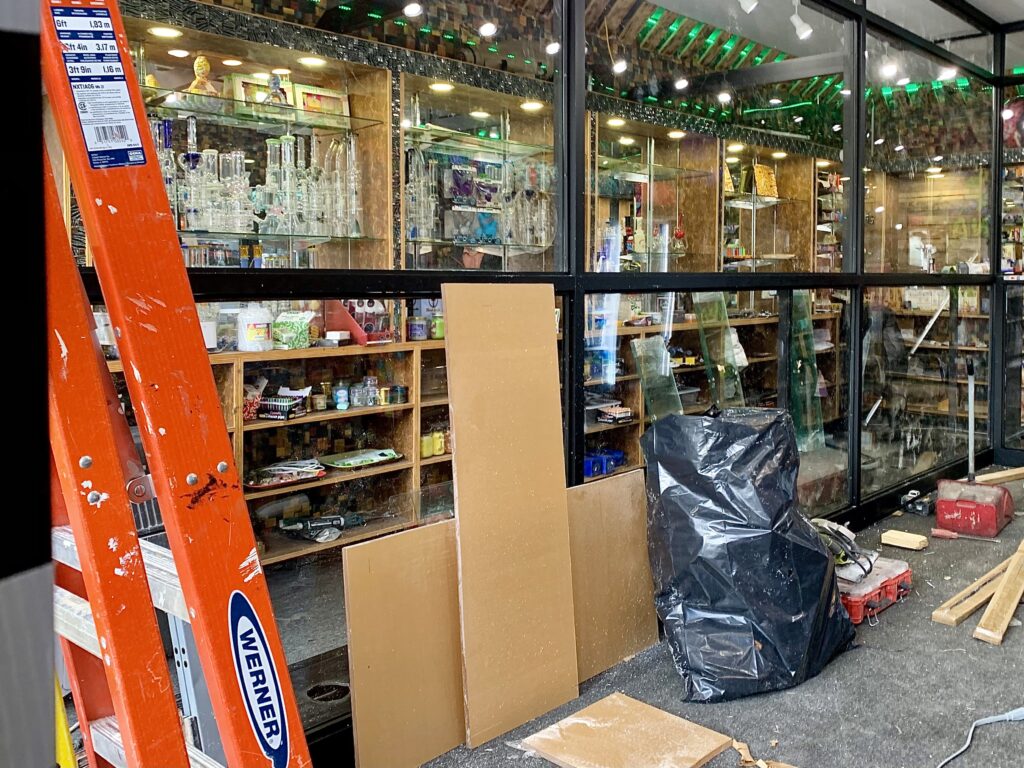
A construction shed now covers the storefront once occupied by the Launder Center, at the corner of 7th Avenue and 8th Street in Park Slope. The 7th Avenue Donut Shop and Luncheonette will soon relocate into the space from its cramped quarters a few doors up the street, officially marking the end of one era and the beginning of another.
When the Launder Center closed, just over a year ago, its passing was barely noticed, which is not terribly surprising. It was no grand edifice or marble monument, which is how people normally think of historic landmarks. Also, there are few people still around Park Slope who remember the day in 1947 when the Launder Center opened.
It was in that time after World War II when factories were still re-gearing for domestic consumption and washing machines were a precious commodity. That first day of business, people waiting to get into the launderette lined up all the way down 8th Street to the Park Slope Branch Library on 6th Avenue.
The line was so long that the launderette's proprietors, Peggy and Benjamin Stafford, got a ticket for âobstructing walking traffic.â (The more common term for self-service laundries, Laundromat, is a registered trademark, so the Staffords always called their establishment a âlaunderette.â)
The launderette was a first for Park Slope and missed being the first in all of Brooklyn by just one week, said Peggy and Benjamin's daughter, Joan Stafford Beasley. âIt was also a first,â recalled Joan, âfor all those people to be out there in public with their bags of dirty laundry. That was something that was just not done in those days.â
Joan, talking a few months after the Launder Center closed and, sadly, only shortly before her death, said that the launderette was Peggyâs idea, which wasn't at all surprising. âMy mother was liberated way before her time.â
As proof, she told how Peggy Carney left her family in County Mayo, Ireland at age 19 and headed for America on her own. She came straight from the boat to Park Slope, to an aunt who lived on 5th Street between 8th Avenue and the park.
âHer first day here they put her on the Cyclone at Coney Island,â said Joan, recalling a favorite family story. âThe last thing she wanted was a roller coaster ride after being seasick the whole way over.â
Peggy, who Joan described as a beautiful young lady, got a job as a waitress at Schrafts in downtown Brooklyn, and then became a live-in maid in the Hamptons.
Joanâs father, Benjamin Stafford, was also from Ireland, from County Cavan. He had found work in the Hamptons as a butler and chauffeur, and he and Peggy met on a Sunday, when they both had the day off. Benjamin had borrowed the bossâs Model T and Peggy thought the car was his. By the time the young Catholic woman found out otherwise - not to mention that Benjamin was a Protestant - âshe was in love with the man with the bright blue eyes.â
Joan told another favorite family tale: âWhen he asked her to marry him, she asked how much money he had. He said five. She thought he meant five thousand, when the truth was five dollars. But even that didnât stop them.
âThey were freethinkers, as my mother liked to say,â recalled Joan, âso they got married when Irish Catholics and Protestants werenât supposed to do such things.â
They moved to Park Slope, to a home between 7th and 8th Avenues on Union Street, and Benjamin got a job with Squibb Pharmaceuticals. In 1937, when Peggy was pregnant with Joan, they moved to an apartment on 7th Avenue, above a grocery store across the street from the future site of the Launder Center. After Joan was born in Methodist Hospital and Peggy was pregnant with her second daughter, Dorothy, they moved down the Avenue to the corner of 2nd Street.
Peggy was not content to sit at home and raise her daughters, who were both students at P.S. 39 (Joan was in its last 8th-grade class, before it became just an elementary school). Peggy lost out on a chance to buy a boarding house but then set her eyes on a building for sale at 306 7th Ave. (now Tonioâs Italian Restaurant). The young couple raised the money for a down payment (Joan thought the building cost all of $9,000). Peggy opened a five-and-dime in the front of the building while the family moved into two rooms in the back.
âEvery Sunday, weâd ride the subway to Delancey Street on the Lower East Side to buy things for the store: thread, notebooks, ironing boards, whatever,â said Joan. âI learned that Jewish people were just like us, that there was no difference. It was a lesson I never forgot.â
About a year after World War II ended, Peggy was the sole woman among hundreds of men who went to the Concord Hotel in the Catskills to hear a sales pitch on a brand new concept: self-service laundries. She came back to Park Slope and convinced Benjamin that they should sell their building and the five-and-dime and buy the building for sale up the street, the one with a storefront space big enough for washing machines and extractors - there were no dryers at first. They opened the Launder Center, and the family moved in upstairs.
Benjamin quit his job and learned how to keep the machines running while Peggy ran the business. They were so busy, remembered Joan, that the best way for the girls to see their parents was to help out downstairs. They made up packets of soap and bleach that they sold for five cents, and they delivered wet laundry to customerâs homes, sometimes earning a tip.
âNothing comes easy, and it was a difficult life, but it was also a good one,â Joan commented. âFamilies need to work together.â
The launderette became an informal neighborhood center. Out front was what everyone called the âbullshit bench,â a moniker Joan offered with an apologetic âpardon my French.â
âA lot of deals were made on that bench, and, this being Park Slope, where everyone talked to one another, the bench was always occupied.â
Joan described Park Slope in the 1940s and â50s as a close-knit neighborhood that included many first-generation immigrants like Peggy and Benjamin. People would sit on their front stoops - or on the bench in front of the Launder Center - and say hello to everyone who walked by.
By the 1960s, however, the neighborhood had changed in ways that made Joan uneasy. She was married by then, with three children, and she and her husband decided to join many thousands of others who were leaving Park Slope. The Verrazano Bridge had just opened, so they opted for Staten Island.
âThatâs when they started calling it Park Slop,â she recalled. âIâd sit out on the bench and ask, âWhere have all the families gone?â Then I started getting scared for my son, who was eight. I caught him hanging out on a roof and decided it was time to leave. That was a big move. Then the rest of the family followed.â
Benjamin died at age 69 in 1976, and the next year Peggy turned the business over to Joan. In 1983, Joan and her then-husband, Ron Beasley, bought the building across the street from the launderette, on the northwest corner of 7th Avenue and 8th Street.
âThe building had a storefront and we werenât sure what to put in it, so we stood out on the street and asked people walking by what kind of business theyâd like to see us open. Lots of people said a restaurant, because there werenât many in the neighborhood then, so thatâs what we did.â
They called the restaurant the Carriage House, because thatâs what the building had been originally. âItâs where the rich people who lived up on 8th Avenue parked their buggies. Where Smiling Pizza is now is where they bought their hay.â
For many years, both establishments did well, but then came harder times. Joanâs marriage ended and the restaurant gave way to a bar (now called the Carriage Inn). Through it all, Joan came in from Staten Island every day, running back and forth between the two businesses, wearing one uniform on top of the other.
When the family decided last year that the time had come to close the launderette and sell the building, they kept the bench, the clock, the laundry scales, and a table that held the pot that dispensed free coffee. Before that, the same table had held a tree each Christmas at the five-and-dime. These relics along with old photos have been moved into a kind of shrine at the Carriage Inn.
Peggy died âwith all her facultiesâ at age 93 in 2000, and the bar is now run by Joanâs daughter, Dorothy. While Joan confessed to disappointment that it is no longer a restaurant, she was also very proud of how much she sees of Peggy - and herself - in the way Dorothy runs the Carriage Inn.
âItâs a friendly place, where everybody knows everybody, and if they donât know you, youâre still welcome.â It reminded her of the Park Slope she knew as a child and that she saw making a comeback.
âSure, thereâs been an influx of new people, but theyâre interesting people. If you want to say hello and be friendly you can do it. Itâs a neighborhood. Thatâs what Park Slope is. I never felt that in Staten Island. I donât feel that in Houston, where I spend winters now.â
Joan told one last story, about how she still carries a scar from when she cut her leg as a young girl climbing over the fence at P.S. 39.
âWhen it happened, I was bleeding badly and a man picked me up and carried me to my mother at the five-and-dime. He was wearing a good suit that got covered in blood. It was a wonderful act of kindness - the kind of thing that happens in Park Slope.â
Something else laudable will happen in Park Slope when the 7th Avenue Donut Shop and Luncheonette moves to its new quarters: one neighborly mom and pop store will be replaced by another. The family-run Donut Shop has been around since 1978, and is strongly part of the Launder Center and Carriage Inn tradition of greeting regular customers by name.
A version of this article originally appeared in the Park Slope Civic Councilâs Civic News.
Questions? Comments?
Sound off to the Editor
ââââââââ
© Brooklyn Daily Eagle 2009
All materials posted on BrooklynEagle.com are protected by United States copyright law.
Just a reminder, though -- Itâs not considered polite to paste the entire story on your blog. Most blogs post a summary or the first paragraph,( 40 words) then post a link to the rest of the story. That helps increase click-throughs for everyone, and minimizes copyright issues. So please keep posting, but not the entire article. arturc at att.net