Archives
Brooklyn Public Library's
Brooklyn Daily Eagle Online™
(1841-1902)

Archives
Brooklyn Eagle™
(2003-present)

Sign In
ID is your email Password
For registration questions click here

Categories
Main page
RSS Channels
Atlantic Yards
Photo Galleries
Brooklyn Today
Brooklyn People
Brooklyn Cyclones
Courthouse News & Cases
Brooklyn SPACE
Features
Crime
Sports
Street Beat
Brooklyn Inc
Brooklyn KIDS
Editorial viewpoint
OUTBrooklyn
Brooklyn Woman
Art
Up & Coming
Hills & Gardens
Auction Advertiser
On Food
Health Care
Get A LifeStyle
On This Day in History
Obituaries
Community Boards
Stars and stripes
Community News
Local Search

Contact Us
If you'd like to contact us click here


For registration questions click here

Read about Us HERE
 
Business: Location:
 
Appliance Repair
Car Dealers
Car Repair
Carpet Cleaners
Child Care
Chiropractors
Computer Repair
Contractors
Dentists
Dry Cleaners
Electric Contractors
Golf
Hotels
Landscapers
Lawn Maintenance
Lawyers
Limousines
Locksmiths
Optometrists
Pest Control
Physician & Surgeons
Plumbers
Restaurants
Salons
Full Directory

You are not logged in. Register now. February 9, 2010

On This Day in History: July 23
Birth Anniversary of the ‘Captain’
by Vernon Parker (history@brooklyneagle.net), published online 07-23-2009
 

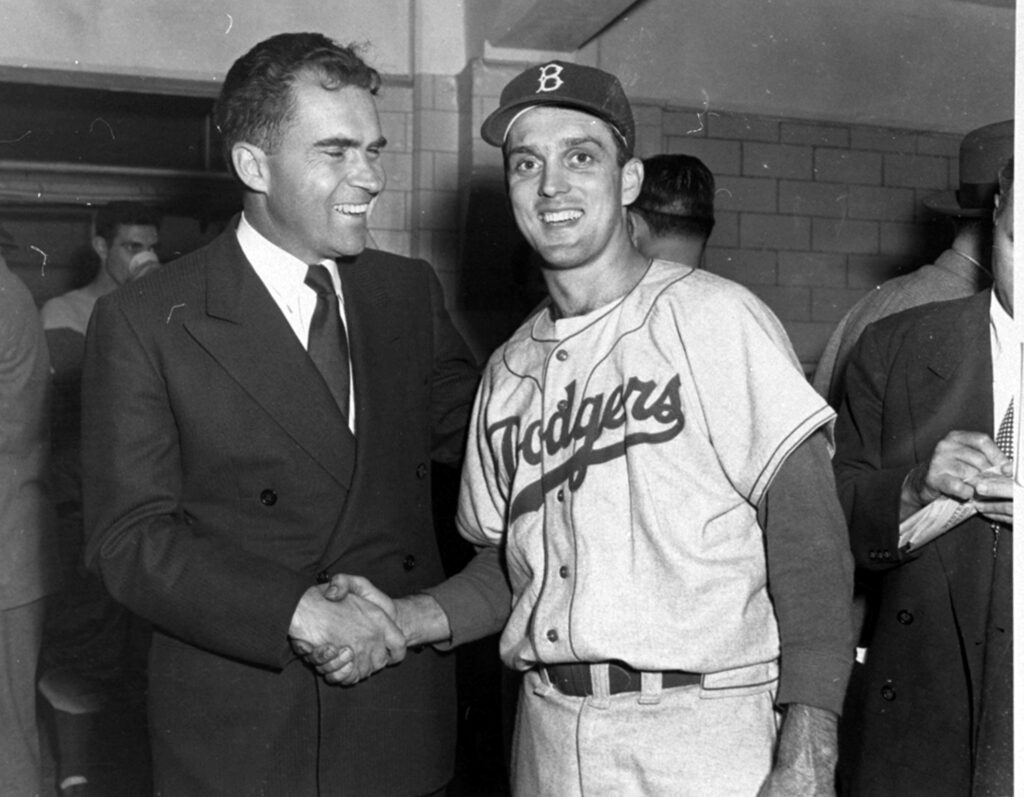
A quarter-century after he last led his teammates out of the Ebbets Field dugout to start a game, Pee Wee Reese reflected on how he still retained the admiration of the old Brooklyn Dodgers. “Most of the players that are still alive to this day call me Captain,” he said. And what a captain he was!

Harold Henry Reese was born on July 23, 1918 in Ekron, Kentucky, some 45 miles south of Louisville, the son of a railroad detective. Since the age of 12, he carried the nickname of Pee Wee, a tribute to pee-wee marble-shooting skills that carried him to the finals of the Louisville marble-shooting championship tournament.

He was all of 5 feet 9 inches and 140 pounds when he began his professional career with the Louisville Colonels of the American Association in 1938. Yet he was so impressive as shortstop that the Boston Red Sox later bought into the minor league team to insure the rights to Reese. But the Boston manager, Joe Cronin, was also the team’s shortstop and was not ready to quit. So Reese was sold to the Brooklyn Dodgers for a reported $40,000 after his second year at Louisville.

Reese was bought up by Brooklyn in 1940, envisioned as the successor at shortstop to the Dodgers’ manager, Leo Durocher. He was sidelined for much of his rookie season by a beaning and a broken foot, but in 1941 Reese became a regular, teaming with outfielder Pete Reiser for a youthful spark on an otherwise veteran team that captured the Dodger’s first pennant in 21 years.

Reese enlisted in the Navy after the 1942 season and played baseball on naval teams

in Virginia and the Pacific. When he returned for the 1946 season, a new era was emerging in baseball, and he faced an unexpected test.

“I was aboard ship, coming back from Guam,” he remembered. “Someone on the ship knew who I was. He told me, ‘Pee wee, the Dodgers signed a black.’ And I kind of laughed about it. I said: ‘You gotta be kidding. They wouldn’t sign a black.’ They always said the blacks couldn’t play under pressure; things got hot, they would fold up.

“Maybe an hour or two later, he came back and told me — this same kid — said he was not only a black, but he was a shortstop. Now then, he caught my attention.”

But when Jackie Robinson joined the Dodgers in 1947, Reese set a tone of tolerance. When another Southerner on the Dodgers, Dixie Walker, instigated a petition against Robinson, Reese refused to sign it. And he made a gesture that spoke loudly.

During an exhibition game in Fort Worth, where raucous, racist spectators belabored Jackie, Reese strolled to Robinson’s side, draped an arm encouragingly over his shoulders and spoke a few soothing words. The harassment subsided. And Duke Snider recalled a similar situation at a Boston game early in that rookie season: “... some of the Braves players began to heckle Pee Wee being a Southerner and playing ball with a Negro. Pee Wee didn’t answer them or even look at them. He just walked over to Jackie and put his hand on his shoulder and began to talk to him. That shut the Braves right up.” “He was standing by me,” Robinson said later. “I will never forget it.”

Years later, Reese said: “I wasn’t trying to think of myself as being the Great White Father. It didn’t matter to me whether he was black or green, he had a right to be there, too.”

After playing at first base as a rookie, Robinson shifted to second, combining with Reese for a superb double-play combination in the years to come.

Reese became captain of the Dodgers. During his 15 seasons with the team they won seven pennants, finished second six times and wound up in third place twice. Reese’s teammates highly respected him and looked to him for counsel and advice on and off the field. Reese was one who could cool inflamed tempers in a turbulent clubhouse.

Reese batted .300 only once, reaching .309 in 1954. His most productive RBI season was 1951 when he drove in 84 runs, and his best power season was 1949 when he smacked 16 home runs. Always a threat on the bases, Reese led the National League with 30 stolen bases in 1952. When the Dodgers moved to Los Angeles, Reese went with them. In 1958 he concluded his playing career with a lifetime batting mark of .269. He served as LA Dodgers coach in 1959 and then retired from baseball.

On July 22, 1955, the eve of his 37th birthday, Reese was accorded the grandest tribute for a Brooklyn player — Pee Wee Reese Night. In a pre-game ceremony at Ebbets Field lasting 50 minutes, Reese received gifts included a home freezer with 200 pounds of food. Seven different autos were driven onto the field and his 11-year-old daughter, Barbara, reached into a fishbowl and picked out one of seven ignition keys. (It fit the Chevrolet). And in the middle of the fifth inning, two huge birthday cakes were wheeled onto the field. The lights were dimmed and the 33,003 fans struck matches or cigarette lighters, stood and sang “Happy Birthday.”

When Reese was elected to the Baseball Hall of Fame in 1984, the Little Colonel was representative of the Hillerich & Bradsby Co., manufacturer of Louisville Slugger bats. He was an All Star nine times. After undergoing a battle with lung cancer since 1997, for which he took radiation treatments following surgery, Pee Wee Reese died August 14, 1999 at his home in Louisville, Kentucky.

— Vernon Parker

————————

© Brooklyn Daily Eagle 2009 All materials posted on BrooklynEagle.com are protected by United States copyright law. Just a reminder, though -- It’s not considered polite to paste the entire story on your blog. Most blogs post a summary or the first paragraph,( 40 words) then post a link to the rest of the story. That helps increase click-throughs for everyone, and minimizes copyright issues. So please keep posting, but not the entire article. arturc at att.net


Daily Cover

Weekly Cover

Real Estate Brooklyn

Bay Ridge Eagle