Author Also Believes 2nd Ave. Subway
Plan Short-Changes Brooklynites
By Raanan Geberer
Brooklyn Daily Eagle
BAY RIDGE — Last week, city officials and others celebrated when a new groundbreaking ceremony was held in Manhattan for the star-crossed Second Avenue subway.
This wasn’t the first time — in the early 1970s, several sections were actually dug, but construction ended when the city declared bankruptcy in 1975. And even earlier, a bond issue in the early 1950s allocated money for a Second Avenue subway project, but the funds were diverted to fixing up existing lines.
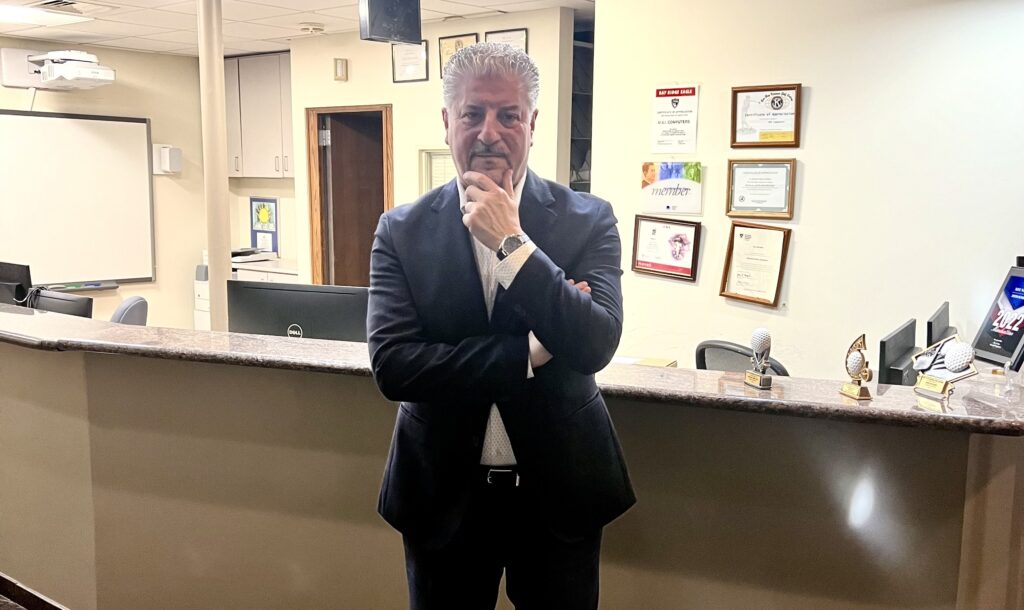
On this uncertain note, it is interesting that Larry Stelter, longtime Bay Ridge civic activist, amateur historian and transit buff, is planning to reissue his 1995 book “By the El: Third Avenue and Its El at Mid-Century.” The Third Avenue El, most of which was demolished in 1955, was supposed to have been replaced by the Second Avenue subway. But instead, riders were left out in the cold.
Furthermore, even though the Third Avenue El only ran in Manhattan and the Bronx, both the el and the Second Avenue subway proposal have important ramifications for Brooklyn riders.
Stelter, who works as an architect for the city, has been a member of Community Board 10; serves as vice president of the Bay Ridge Historical Society; and is the co-author, along with Peter Scarpa, of “Images of America: Bay Ridge,” issued in 2001.
The genesis of “By the El” came when Stelter came across a series of photos his father, who commuted regularly from the Bronx to Manhattan on the Third Avenue El, had taken in the early ’50s, when people already assumed that the el would soon come down. Stelter stresses that the Manhattan els and the old Brooklyn els (Fulton Street, Lexington Avenue, Myrtle Avenue) both were built during the 19th century and employed similar construction.
The early 1950s bond issue that would have paid for the Second Avenue Subway, Stelter adds, would also have paid for extensions of the IRT lines from Utica Avenue and from Brooklyn College-Flatbush Avenue. So when the city diverted the funds, Brooklyn riders lost out as well as Manhattan riders.
Stelter’s father’s photos show a world that has been lost to history. Instead of the trendy Third Avenue of nowadays, we see a street of pawnshops, antique stores and bars. We also see Victorian ironwork, Swiss chalet-type stations and stained-glass windows — even in the ’50s, the stations basically looked the same as they did when they were built in 1878.
Unfortunately, when the el was demolished, the preservation movement, which incidentally got started in Brooklyn Heights, had yet to take shape. Most of the stained glass windows and other Victorian details were destroyed. So were the old wooden trains — the book contains an eerie photo of them burning together in a big bonfire. Stelter’s father, fortunately, was able to save one piece of stained glass and several old signs.
The upcoming issue of the book has several additions to the earlier version. For example, it now has a section on the Bronx portion of the el, which wasn’t destroyed until 1973, featuring photos that Larry Stelter himself took in the early ’70s.
As for the current plans for the Second Avenue Subway, Stelter criticizes the city and the MTA for not including any connections to either Brooklyn or the Bronx. Both the early 1950s plan and 1968 plan included tie-ins to Brooklyn lines.
As a matter of fact, he says, the Chrystie Street connection, which connects the Sixth Avenue subway in Manhattan to the Manhattan Bridge and allows the D and B trains to proceed to Coney Island, was originally planned as a Second Avenue subway connection.
“The current route would start at Hanover Square — it doesn’t even go to South Ferry — and dead-ends at 125th Street. I call it the Manhattan shuttle,” says Stelter, who objected to the plan in his capacity as a member of the Brooklyn Borough President’s Transportation Advisory Board.
Speaking of els, there was also a Brooklyn Third Avenue el, which ran right in Stelter’s neighborhood of Bay Ridge. But after the Fourth Avenue subway was opened in the 1910s, it was rarely used, and it was finally torn down in 1940.
© Brooklyn Daily Eagle 2007
All materials posted on brooklyneagle.com are protected by United States copyright law and may not be reproduced, distributed, transmitted, displayed, published or broadcast, posted on Gotham Gazette.com or any other blog without written permission, which can be sought by emailing arturc@att.net.
Main Office 718 422 7400