Futurists’ Workshop Attracts
Students From All Over World
By Stephen Rex Brown
Brooklyn Daily Eagle
BROOKLYN — When Dr. Mitchell Joachim appeared on the Colbert Report he was only a short subway ride from his laboratory, where he and a group of fellow futurists envision a world where New Yorkers travel by jet pack, live in tree houses, and wear wristwatches made of in-vitro pig meat.
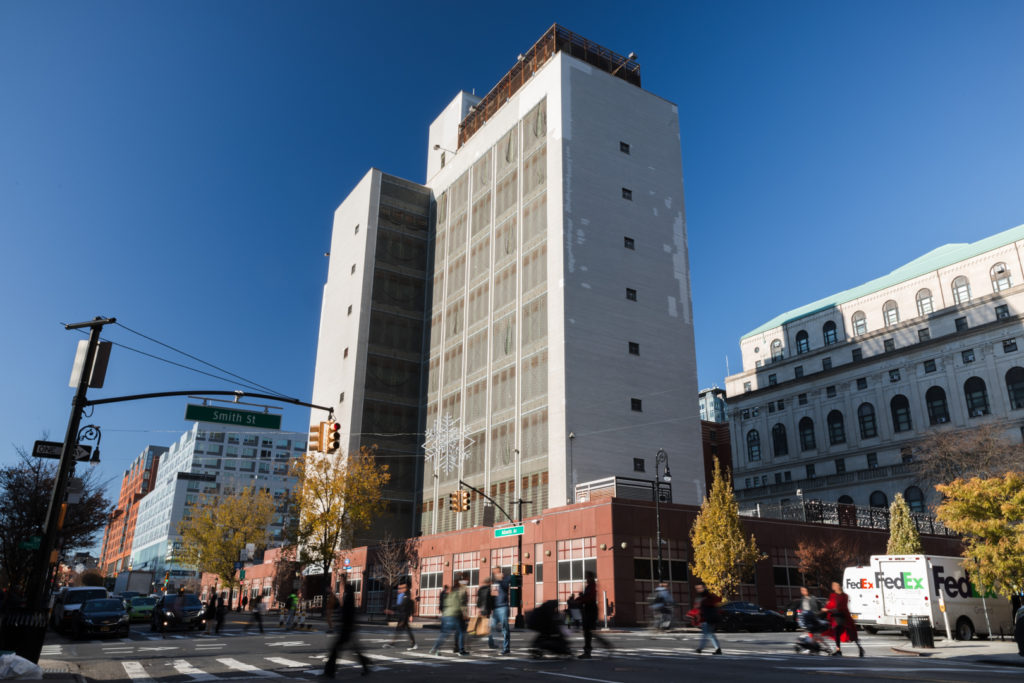
Despite the short trip, Joachim’s moment in the spotlight was a world apart from the Metropolitan Exchange Building on Flatbush Avenue, where he hatches the provocative ideas that earned him a spot on the 2008 “Smart List” in Wired magazine.
Now, Joachim’s non-profit group, Terreform One, is allowing a group of 40 students from all over the globe to revel in their world of apparently limitless possibilities, where ideas for urban agriculture seem out of a science fiction novel.
“The environmental movement is so much about a doomsday scenario—the end of the world,” Maria Aiolova, co-founder of Terreform One said, standing in front of a painting with small plants bursting out of the piece. “We come up with funky and fantastic opportunities that can be applied in a different way.”
The fact that Terreform was swamped with 130 applications in the inaugural year of the four-week-long seminar is a reflection of the concern surrounding climate change and the desire to find solutions.
Community gardens are sprouting all over Brooklyn — there are 245 in Brooklyn alone, according to the Parks Department — and farmers markets continue prospering with the rise of the “slow food” movement. The students, who came from as far as Bulgaria and New Zealand, got a crash-course in the eco-movement in Brooklyn during the first week, attending two lectures a day by experts in the field.
“It’s tremendously empowering,” Rashmi Ramaswamy, an architect with 15 years of experience said. “There is such a free exchange of ideas, not so much ‘is this feasible, is this not?’”
Joachim’s appearance only adds to his mad-scientist appeal: On Friday he was casually dressed, with his dreadlocks reaching down to his lower back. His provocative concepts have garnered much attention. Rolling Stone listed him as one of the “100 People Who Are Changing America” in 2009 through his “radical green rethink of the American city.”
‘Fab Tree Hab’
One of Joachim’s more famous concepts, “the fab tree hab,” is a literal tree house that would provide shelter and food. The blueprints for the house, though bizarre, are not beyond the realm of possibility; The Terreform crew are growing a prototype “tree hab” on the roof of the Metropolitan Exchange Building.
The students concluded their first week of the seminar last Friday by listening to Viraj Puri of Gotham Greens explain his plan to build a 10,000 square-foot hydroponic greenhouse in Jamaica, Queens. Puri also used the lecture to recruit the students to the environmental movement.
“If all the bridges and tunnels into New York City were suddenly impassable, the city’s food supply would only last 36 hours. We need you to help us solve this problem,” Puri said.
The students were a motley crew; some were still in college, others well into their careers. The vast majority were involved in architecture and agriculture — a poet and an actress added an artistic element to the group. It is doubtful even the most imaginative of them could have envisioned the unorthodox classroom where they would study.
The lectures took place in the lobby of the Metropolitan Exchange Building. The students sat on a random assortment of chairs, surrounded by posters detailing architecture projects in Brooklyn.
17,000 Square Feet of Junk
Behind the partitions, the junk began. In total, there was roughly 17,000 square feet of it.
The owner of the Metropolitan Exchange Building has been hoarding random objects since he bought it in 1978. One floor was filled with dozens of doors, furniture, carousel horses from the Coney Island Steeplechase, an old defibrillator, an issue of Playboy from the 1980s and a sleigh.
This week the students will journey to the High Line in Manhattan, the Red Hook community garden and other sites to get a look at the vanguard of the urban agriculture movement in New York. After the trips, it will be the students’ job to figure out how to put all the junk in the Metropolitan Exchange Building to good use by designing gardens with the unlikely objects.
Joachim is the perfect instructor for such a project. He recently began preparing a molecular cell biology lab where he will grow animal tissue — specifically pig knees and kidneys — and experiment with different ways to put the meat to use. Joachim pointed to a model of a “meat house,” roughly the size of a football, that was made of cancerous pig tissue. “You grow the meat, dry it, make jerky out of it, and then we’ll try and make watchbands, handbags,” Joachim said with a straight face.
The Metropolitan Exchange Building seems to attract innovative thinkers like Joachim. “This is the only place where I could have a molecular cell biology lab next to a wood shop and a metal shop,” Joachim said. Indeed, the building is a house of ideas, with “Denim Therapy,” a jean repair service, working alongside various sustainable food businesses and artists.
The sales pitch for the seminar on Terreform’s Web site says that students will be able to immerse themselves in “the intense environment” at the building. And by Friday, the students had been bombarded with so much information that some of them appeared to be suffering from eco-fatigue. But before class was over, the students had one more speaker who put all the other characters in the building to shame.
“We wanted to give the students a more artistic, poetic point of view after so much science,” Aiolova explained. So, they called Vito Acconci, an eccentric poet-performance artist-architect, who detailed his long, successful career in the New York art scene.
Acconci’s descriptions of his performance pieces, including “Following Piece,” in which he stalked a random person everyday for a month, and “Claim,” in which he blindfolded himself in a basement at the base of a set of stairs and menaced visitors with a crowbar and two lead pipes.
Acconci openly admitted he lacked technical expertise in architecture Nevertheless, he is responsible for numerous high-profile pieces, including the subway station at Coney Island, which features wave-like structures that curve into benches for straphangers waiting on the platform. His design of a new type of umbrella that resembled a small parachute attached to a person’s waist, hinted at how his previous career in the art world had contributed to his ideas.
Hadley Musselman, an art student from Minneapolis in her sixth year of college, explained that for her urban agriculture was, in the end, an absolute necessity. “I want to learn how to grow vertical gardens in my windows,” Musselman said, adding, “I’m interested in low-tech solutions because I’m broke and so are all my friends.”
Questions? Comments?
Sound off to the Editor
————————
© Brooklyn Daily Eagle 2009
All materials posted on BrooklynEagle.com are protected by United States copyright law.
Just a reminder, though -- It’s not considered polite to paste the entire story on your blog. Most blogs post a summary or the first paragraph,( 40 words) then post a link to the rest of the story. That helps increase click-throughs for everyone, and minimizes copyright issues. So please keep posting, but not the entire article. arturc at att.net