Archives
Brooklyn Public Library's
Brooklyn Daily Eagle Online™
(1841-1902)

Archives
Brooklyn Eagle™
(2003-present)

Sign In
ID is your email Password
For registration questions click here

Categories
Main page
RSS Channels
Atlantic Yards
Photo Galleries
Brooklyn Today
Brooklyn People
Brooklyn Cyclones
Courthouse News & Cases
Brooklyn SPACE
Features
Crime
Sports
Street Beat
Brooklyn Inc
Brooklyn KIDS
Editorial viewpoint
OUTBrooklyn
Brooklyn Woman
Art
Up & Coming
Hills & Gardens
Auction Advertiser
On Food
Health Care
Get A LifeStyle
On This Day in History
Obituaries
Community Boards
Stars and stripes
Community News
Local Search

Contact Us
If you'd like to contact us click here


For registration questions click here

Read about Us HERE
 
Business: Location:
 
Appliance Repair
Car Dealers
Car Repair
Carpet Cleaners
Child Care
Chiropractors
Computer Repair
Contractors
Dentists
Dry Cleaners
Electric Contractors
Golf
Hotels
Landscapers
Lawn Maintenance
Lawyers
Limousines
Locksmiths
Optometrists
Pest Control
Physician & Surgeons
Plumbers
Restaurants
Salons
Full Directory

You are not logged in. Register now. February 9, 2010

Centennial for an Overshadowed Landmark
by Phoebe Neidl (phoebe@brooklyneagle.net), published online 09-24-2009
 

By Phoebe Neidl
Brooklyn Eagle

It’s fair to say that the Manhattan Bridge has always stood in the shadow of a certain other East River span. When the Brooklyn Bridge was completed in 1883, connecting the two great cities of New York and Brooklyn, it was a celebration for the ages, attended by U.S. President Chester Arthur, and pretty much all of New York.

At the time it was built, the Brooklyn Bridge was the longest suspension bridge in the world, longer than any other by half, and was called the eighth wonder of the world. Its centennial, celebrated in 1983, was accompanied by a cover story in National Geographic and a fireworks display that locals speak about with awe to this day.

On the contrary, “the most impressive thing about the official opening” of the Manhattan Bridge, “was that it was Mayor [George] McClellan’s last formal act before handing over the keys of the city to the incoming administration,” according to a New York Times article published the day after the Manhattan Bridge’s comparatively humble beginning on December 31, 1909.

New Yorkers had become accustomed to the opening of great bridges between the boroughs, it was said at the time by former Brooklyn Bridge President William Berri. It was, after all, the fourth suspension bridge over the river, the Williamsburg and Queensboro bridges having already been completed.

So it’s not the oldest and it’s not the longest, and has even been plagued by a series of structural problems. But the New York City Bridge Centennial Commission is giving the Manhattan Bridge its moment in the sun, with a week-long centennial celebration next week, complete with a parade of historic vehicles, walking and bike tours, public discussions on the history and construction of the bridge and, yes, fireworks.

“I know every rivet and every bolt of the Manhattan Bridge,” says Dave “The Bridge Man” Frieder, who will deliver a lecture on the Manhattan Bridge at the Brooklyn Historical Society on October 8 as part of the centennial festivities.

Frieder benefits from a unique perspective on the bridge. He’s climbed to the top of it about 13 times. “I’m not afraid of heights,” he says.

Lugging 50 pounds of photographic equipment, strapped in a harness, he walked his way up the cables. For eight years prior to 9/11, Frieder had unprecedented access to the city’s bridges as he took photos for a coffee-table book on the subject. He’s climbed more than a dozen of the city’s major bridges.

“It’s my favorite bridge. It’s not very well designed, but it has more architectural embellishments than any other,” says Frieder. “There are these spheres on top of the towers, and this diamond pattern all over…Only me and the iron workers have seen them, really.”

With its seven lanes of traffic and four subway tracks, the Manhattan Bridge serves approximately 75,000 vehicles, 320,000 mass transit riders and 3,000 pedestrians/bicyclists daily, according to the New York City Department of Transportation.

Designed by Leon Moisseiff, the 1,470-foot bridge consists of four main cables draped over two, sleek piers. However, Moisseiff assumed that the inherent structure of suspension bridges made them stronger and decided as a result not to use stiffening trusses like those used, for example, on the Williamsburg Bridge.

This problem was compounded because Moisseiff placed the subway and streetcar lines (the streetcar tracks were replaced with auto lanes in the 1940s) on the outer edges of the roadway. The heavy moving loads of the trains created a twisting strain on the lightly reinforced deck. Combined with lax maintenance over the years, major reconstruction was required beginning in the 1980s and continuing until 2007, with the rehabilitation of the lower roadway.

Moisseiff, who became a pioneer in the construction of steel bridges, utilized a similar design for the Tacoma Narrows Bridge in Washington State. Four months after the bridge opened in 1940, a minor windstorm caused it to collapse.

The Manhattan Bridge is also noted for its beautiful entranceway on Canal Street. A stone archway styled after the Porte St. Denis in Paris was designed by Carrere and Hastings, the architectural firm that designed the New York Public Library. The Brooklyn approach, which included two statues by Daniel Chester French — allegorical figures of Brooklyn and Manhattan — was dismantled in the 1960s to facilitate traffic. They are now on display in the Brooklyn Museum.

Centennial Events

Saturday, October 3

2 p.m. - 4 p.m. Walking Tour led by Adrienne Onofri over the Manhattan Bridge to Vinegar Hill and DUMBO. Meet at the southwest Corner of Canal and Bowery, Manhattan

Sunday, October 4

7:15 a.m. Bike Tour led by Michael Miscione, which will start on the steps of Borough Hall in Brooklyn and will join up with bridge parade at 9 a.m.

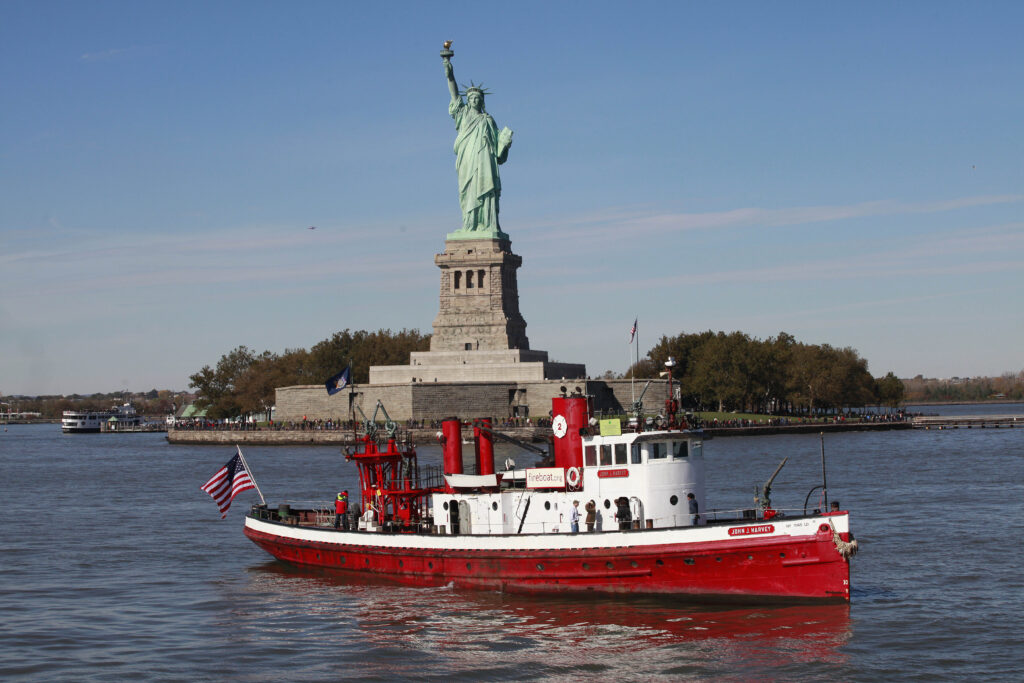
9 - 11 a.m. Centennial Ceremonial Parade By Invitation Only with Manhattan and Brooklyn Borough Presidents and other dignitaries, featuring: Vintage Automobiles, NY Chinese School Marching Band, US Merchant Marine Academy Fanfare Trumpeters and an FDNY Fireboat multi-color salute.

Noon Reception with refreshments in Confucius Plaza, provided by Chinese Community Organizations, 33 Bowery, Manhattan 2 p.m. Dedication of Manhattan Bridge Centennial Time Capsule at Confucius Plaza, 33 Bowery

7 p.m. FIREWORKS by The GRUCCIS of New York! - East River Park Amphitheatre, north of Manhattan Bridge.

Manhattan School of Music Brass Quintet will perform at entrance to park at Jackson and Cherry streets, Manhattan

Monday, October 5

6:30 p.m. Lecture - “Miss Manhattan, Miss Brooklyn and their creator, Daniel Chester French” with Brian Tolle, sculptor, and Karen Lemmey, Metropolitan Museum of Art Historian, at NYU-Poly, 5 MetroTech Center, Main Floor, Brooklyn

Tuesday, October 6

6:30 p.m. “The Manhattan Bridge - History, Construction & Safety” with Michael Miscione, Manhattan Borough Historian; Henry Perahia, deputy commissioner NYC Department of Transportation; and Sam Schwartz at NYU-Poly, 5 MetroTech Center, Main Floor, Brooklyn

Wednesday, October 7

6:30 p.m Lecture - “Bridges of New York” by Phil Eng, New York state Department of Transportation, at the Chinese Consolidated Benevolent Association of NY, Conference Room, 62 Mott St., Manhattan 6:30 p.m. “Manhattan Bridge in Major Motion Pictures” at the Pace University Multi-Purpose Room, 1 Pace Plaza. Entrance location at Spruce Street, Manhattan

Thursday, October 8, 2009

2 p.m. Lecture - “Engineering, Construction and History of the Manhattan Bridge” by Dave Frieder at the Brooklyn Historical Society, 128 Pierrepont St., Brooklyn. $6 admission; free to members of the Brooklyn Historical Society

6 p.m. “Art Along the Way: Masstraniscope with Artist Bill Brand.” Transit Museum, Boerum Place and Schermerhorn Street, Brooklyn. $5 admission

Friday, October 9, 2009

6:30 p.m. Panel Discussion on the Manhattan Bridge by Robert Olmsted, ASCE; Michael Miscione, Manhattan Borough Historian; Sam Schwartz; Jim Rasenberger, and Sewell Chan, reporter for the New York Times. NYU-Poly, 5 MetroTech Center, Main Floor, Brooklyn

6:30 p.m. Reception by Manhattan Borough President for Exhibit of Historic Photographs Municipal Building, 1 Centre Street, 19th floor Conference Room, Manhattan

Saturday, October 10, 2009

10 a.m. 90-minute bike tour sponsored by Transportation Alternatives, led by Noah Budnick. Meet at Grand and Allen streets at redesigned Allen St. Mall, Manhattan

Sunday, October 11, 2009

10 a.m. Walking Tour with Bernie Ente and David Frieder in conjunction with Open House New York. Meet the Canal and Bowery, Manhattan

Noon “Losing the Bridge” - 90-minute Walking Tour with Sam Schwartz in conjunction with Open House New York. Start at Confucius Plaza, 33 Bowery, Manhattan.

1:30 p.m. Transit Museum Workshop for Children, “Bridge City: Manhattan Bridge Turns 100.” Boerum Place and Schermerhorn Street. Free Admission for Members, $3 Children and $5 Adults.

————————

© Brooklyn Daily Eagle 2009 All materials posted on BrooklynEagle.com are protected by United States copyright law. Just a reminder, though -- It’s not considered polite to paste the entire story on your blog. Most blogs post a summary or the first paragraph,( 40 words) then post a link to the rest of the story. That helps increase click-throughs for everyone, and minimizes copyright issues. So please keep posting, but not the entire article. arturc at att.net


Daily Cover

Weekly Cover

Real Estate Brooklyn

Bay Ridge Eagle