Supreme Court Librarian Jacqueline Cantwell Speaks About Preserving Traditions in the Digital Age
By Samuel Newhouse
Brooklyn Daily Eagle
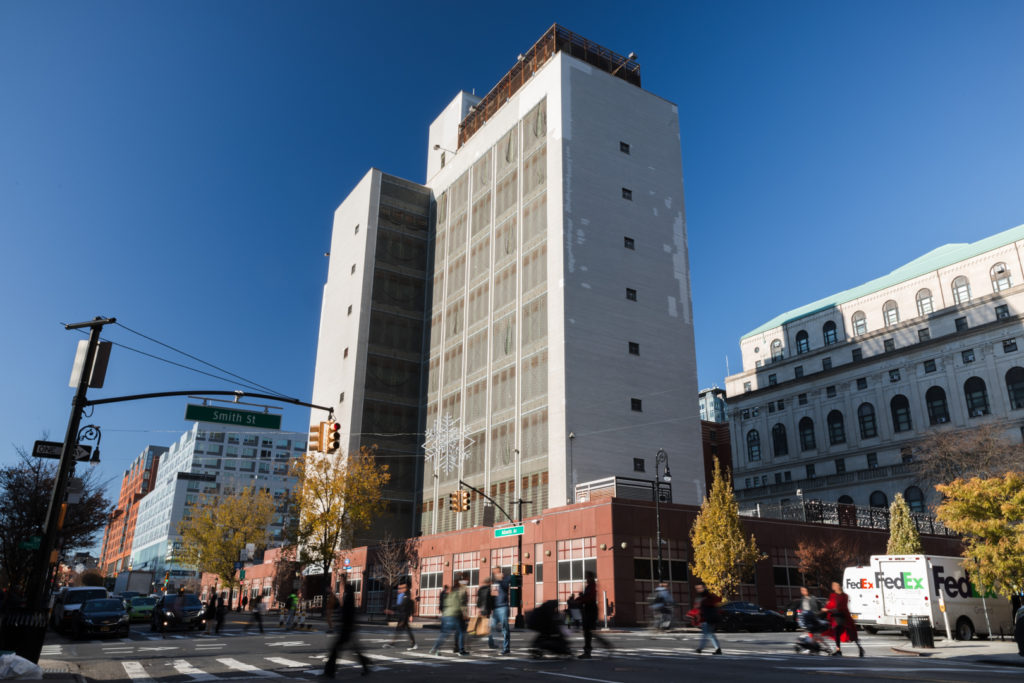
ADAMS STREET – Some of the best-preserved artifacts from Brooklyn’s past are kept in the Supreme Court’s Law Library, or the “Law Library of Brooklyn,” as it used to be called. The library has a collection of about 250,000 volumes, which includes state and city laws and court records dating back to the 1800s.
The library is most frequently used by attorneys and judges, and is also open to the public. Attorneys can find old statutes and decisions regarding laws of every variety. And sometimes judges come to the library to check out the “bill jacket” or legislative history of a particular section of law that they need to make a decision on.
After being chartered in 1850, the library was recognized by law in 1863 as the library of the Second Judicial District, which includes Brooklyn. In 1996, legislation passed that opened the library to all attorneys, not just those who paid annual dues, and also granted access to the public.
It has changed locations a few times over the years, and its current incarnation is a quiet, oak-paneled library on the second floor of the Kings County Supreme Court, with natural light coming in through large windows along one wall.
In one corner is an oil portrait of former head librarian Otto Wexel, who began at the library as an office boy in 1890 and slowly climbed the ranks, working there for decades and continuing to put in occasional days of work after retiring until his death in 1949.
Current senior librarian Jacqueline Cantwell has worked at the law library since 2000. She told the Eagle that it’s “a wonderful job,” and that she finds her work fascinating.
“Attorneys will ask me what are the best books about something like unemployment insurance,” said Cantwell. “And well, maybe I haven’t heard that question before. So I go to the books, standing in front of a stack like a Ouija board, trying to figure out where I’ll find the information I want.”
Cantwell, originally from Buffalo, described herself as “one of those bookish girls who always wanted to be a librarian.” After working in printing houses in California, she earned her MLIS degree at University of California at Berkeley.
MLIS stands for “Master of Library and Information Science.”
She then worked in the legal library of the California law firm of Gibson, Dunn & Crutcher, and then at the Alameda County Law Library in Oakland before being offered a position here in Brooklyn.
“I wanted to be part of a bigger system,” Cantwell said. “This library is a resource to help the court system run more smoothly.”
Cantwell works with a staff of other librarians dedicated to compiling and organizing archival information, including principal law librarian Paul Henrich, senior law librarian Brenda Patel, law librarian Anton Matejka, and clerks Yolanda Montenegro and Sheila Clopse.
Besides trying to assist attorneys in their research, and preserving old legal decisions and laws, the librarians also work to archive new material about current legal affairs. But this duty has become somewhat more complex as they try to adapt to new information technologies.
Even in the digital age, the library still collects new information in print form. To some degree, there is a generation gap concerning which attorneys want online resources and which attorneys prefer to look in a book for research.
“Some of the older attorneys don’t want to go online – but they still get their work done,” Cantwell said. “Some newer attorneys don’t know books at all. They just go to the cases, which are online, and they don’t always see the interconnections between things.”
From Cantwell’s point-of-view, internet research is still a work-in-progress.
She described herself as a “techie” person, and after all, some online databases have astonishing stores of information. She showed the Eagle a legal database that stores British “Statutes of the Realm” dating back to 1235 A.D.
“This shows how interesting libraries are now,” Cantwell said. “You’re looking at a document from the 1400s -- in PDF format -- that in the past would have been hard to find, and now you can get it in Brooklyn.”
But there are still flaws in research technology. Cantwell mentioned that recent research had demonstrated that people looking at an index in a book find accurate results more quickly than those searching for keywords online. Ironically, users doing online searches are more confident in their results.
Cantwell also complained that some databases have terrible search engines, and while an older person who can’t get the technology to work is made to feel like an “old fogey,” the database can sometimes be very ineffective.
“We try to remind people to step back and go to print resources,” Cantwell said. “You need to use both. A book is also a type of technology.”
As part of her dedication to improving online resources, Cantwell recently made a presentation to the American Association of Law Libraries on ways to improve information accessibility and keyword searches.
She said that judges at the Brooklyn Supreme Court had encouraged her to pursue her research, and that in general they are all very supportive of the library. And while working with them, she feels she has become more aware of what it means to work in the court system.
“Judges [John] Leventhal and [Matthew] D’Emic’s work in domestic-violence court really showed me the potential for this job,” Cantwell said. “The two of them revived my dedication.”
“Its easy to get blasé, but what they do in domestic violence, to me, is so noble,” she said. “It made me realize how important this job is to a civil society.”
Cantwell highly values the law library as a place separate from “high-pressure courtrooms” where attorneys and judges can consider legal practice and the law in a space that encourages reflection and contemplation.
But beyond that, Cantwell and her colleagues just focus on preserving the stacks and making new information available to the people who need the library.
“We are the public access library for the downtown courts, and for all of Brooklyn,” she said. “There are smaller chamber libraries. But we’re open to the public from 9 to 6 every day.”
————————
© Brooklyn Daily Eagle 2008
All materials posted on BrooklynEagle.com are protected by United States copyright law.
Just a reminder, though -- It’s not considered polite to paste the entire story on your blog. Most blogs post a summary or the first paragraph,( 40 words) then post a link to the rest of the story. That helps increase click-throughs for everyone, and minimizes copyright issues. So please keep posting, but not the entire article. arturc at att.net