Y’s Renovations ‘Within Budget and Ahead of Schedule’
By Linda Collins
Brooklyn Daily Eagle
DOWNTOWN BROOKLYN — “The fact that we were able to save this building in this real estate market is remarkable,” said Martha Kamber, executive director of the YWCA of Brooklyn.
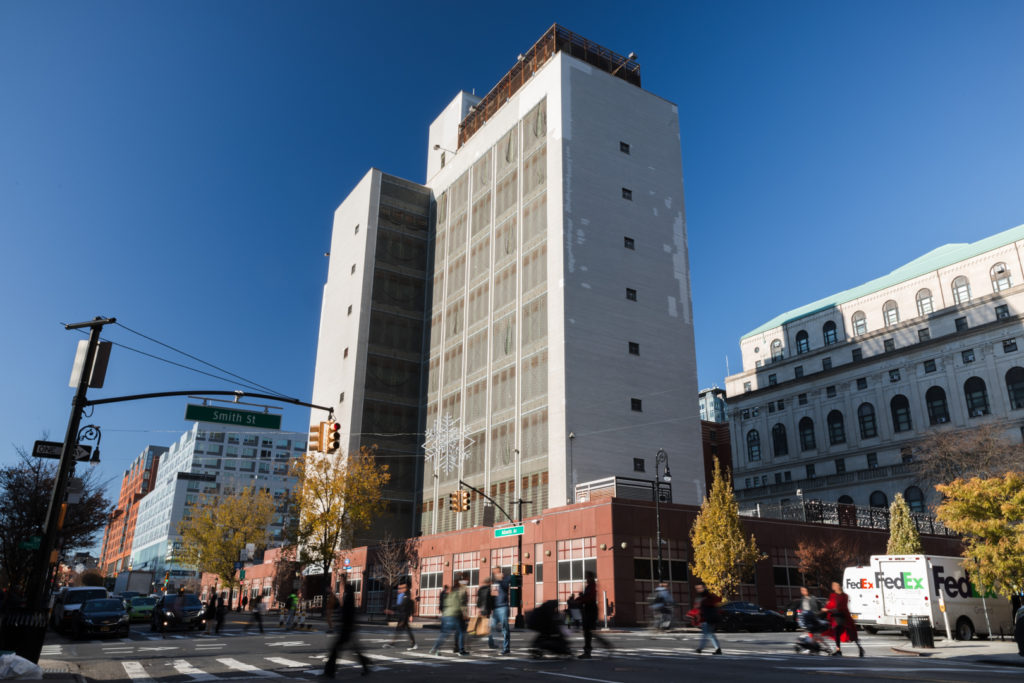
She was speaking of the 79-year-old building at Atlantic and Third avenues in Boerum Hill that in 2005 was mired in debt and in serious disrepair.
But the decision was made to salvage the building.
“Our board did not want to put 200 women out on the street homeless,” she said. “Some of these women have lived here for 50 years, many are elderly and disabled and are on fixed incomes.
“We don’t age our women out [to nursing homes],” she added.
These 200 low-income women, of course, are now enduring what Kamber calls “an occupied renovation,” as the building undergoes some major changes, including the refurbishment of their own (single-room-occupancy) residences on floors 7-11, their hallways, bathrooms and communal kitchens.
“They’re doing very well, I’m proud of them. They really take care of each other,” said Kamber, who also noted that there has not been a single incident between the workmen and the women since construction began in January 2007. “The guys [of Trixline Contracting in Manhattan, a minority-owned and union labor firm] pick up on the more fragile nature of the women and the situation here.”
It is the mission of the Brooklyn YWCA to provide affordable housing to low-income women — including domestic violence survivors and the formerly incarcerated or homeless.
Soon it will offer such housing to 84 more women, possibly as early as fall, bringing the total to just under 300 affordable units in the building.
By cobbling together a combination of federal, state and city funding, grants and private donations, the YWCA was able to save the building, expand its housing and continue two other valuable services and programs available to the community — its women’s health program and teen leadership academy.
The 84 new residences — handicap-accessible studio apartments with kitchens and bathrooms — are being built on floors 3-6. (“Gone is the pool, gone is the gym.”)
Meanwhile Kamber herself has had to learn to adjust to working in a construction zone and to being a construction manager, in addition to her other duties.
She estimates that 300 YWCAs have closed across the country because their boards and their executive directors did not want to become construction managers.
There are other reasons for the closures, of course, she said. They were all built around the same time (1920s-1930s) and were probably all facing the huge issue of building disrepair. They were also probably feeling the pressure to sell their prime real estate to developers. But even more significantly, “there’s a brand new health club on every corner.”
But this YWCA has been a Brooklyn landmark for decades — a home for those in need of a safe, affordable place to stay; the first YWCA in the country to racially integrate its programs and residences; and home to the first nursing school in the country — and was worth salvaging.
It was also a pioneer in the women’s movement, recognizing that gender and racial disparities exist in the area of health, and that programming was needed for victims of domestic abuse.
Other renovations include new windows throughout the building, three new elevators (two passenger, one freight), a new lobby and new fire safety and mechanical systems.
Kamber and the board are also very eager to make the building sustainable. This means eventually installing a green roof along with the energy-saving windows, lighting and boiler.
“And the good news is we’re within budget and ahead of schedule,” said Kamber.
The only element of the building not included in that good news is the theater.
“The YWCA plans to offer a long-term commercial lease for our theater as we were unable to raise sufficient funds to renovate it,” Kamber said, noting that Ingram & Hebron Realty will be seeking either a non-profit or a for-profit operator for the theater.
The design firm is Murno and Veneziale Architects, based in Manhattan, which is well known for its institutional alterations, building restoration and affordable housing.
As previously reported in the Eagle, primary funding for the project came from the city’s Housing Development Corp. (HDC) and its “Low Income Affordable Marketplace Program” (LAMP); the Department of Housing Preservation and Development (HPD) and its “Mixed Income Rental Program” (MIRP); and federal Low Income Housing Tax Credits, allocated by the HPD.
© Brooklyn Daily Eagle 2008
All materials posted on BrooklynEagle.com are protected by United States copyright law.
Just a reminder, though -- It’s not considered polite to paste the entire story on your blog. Most blogs post a summary or the first paragraph,( 40 words) then post a link to the rest of the story. That helps increase click-throughs for everyone, and minimizes copyright issues. So please keep posting, but not the entire article. arturc at att.net